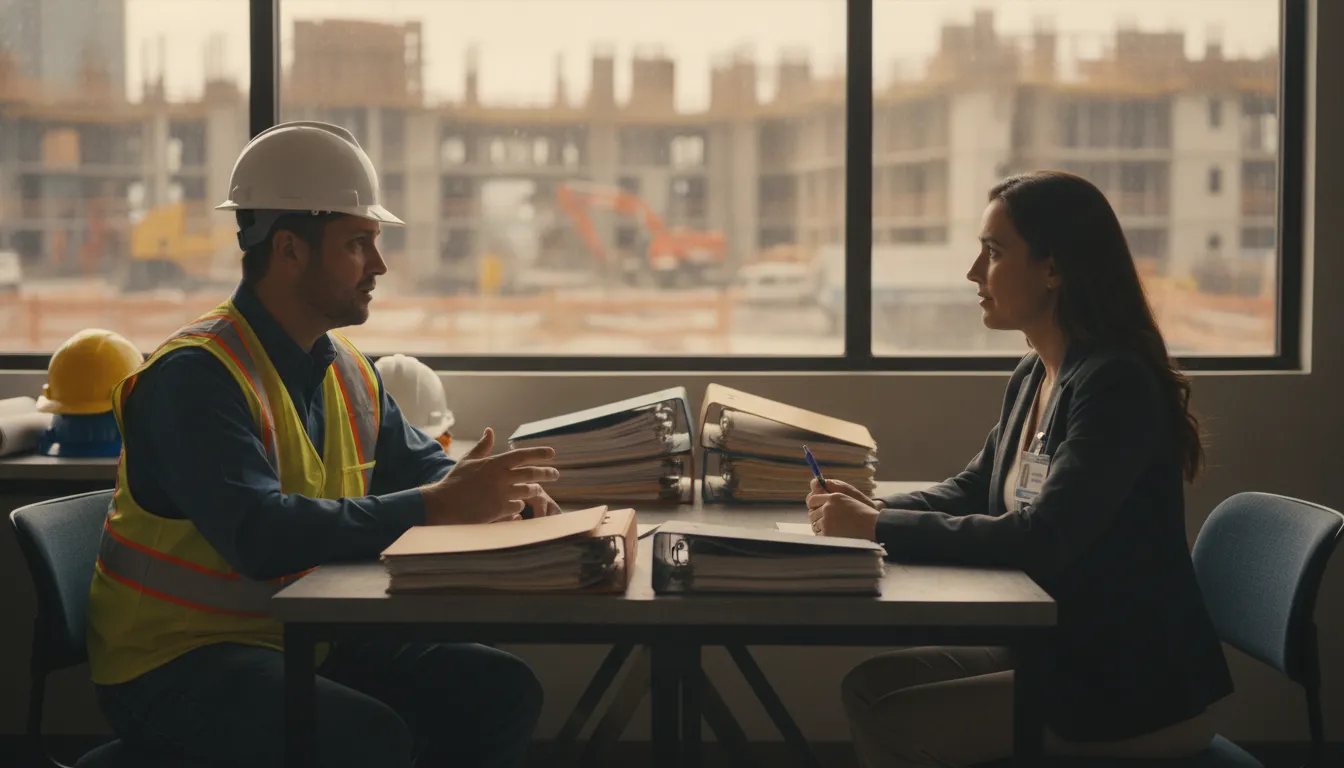
An unpaid construction account is rarely just an overdue invoice. The amount may depend on progress billing, retainage, a change order, the contract, or who sits above and below you in the payment chain. For a California contractor, subcontractor, supplier, or trade professional, recovery also has to account for notices, lien or bond rights, and deadlines that can affect leverage.
Start a construction collection when an earned payment is delayed, disputed, or moving through a complex project chain.
Understanding how construction collections differ from regular debt collection starts with the payment structure: construction recovery combines account outreach with project-document review, role-specific strategy, California compliance, and relationship-aware escalation. A general invoice chase may not identify the remedy or deadline that protects your right to get paid.
At a Glance
- Why progress billing, retainage, change orders, and payment tiers complicate construction accounts.
- How California notices, liens, bonds, and deadlines change recovery strategy.
- Why relationship-aware outreach and organized project records matter.
- When a specialized construction collection review can help clarify the next move.
That is why specialized construction collection services begin by understanding the work, the documents, and the parties involved. The payment chain itself explains why a one-size-fits-all approach can miss the real source of delay and the pressure it creates downstream.
The Construction Payment Chain Is Unlike Any Other Industry
A construction account is rarely a simple transaction between one seller and one buyer. Payment moves through a project structure that can include an owner, direct contractor, subcontractors, specialty trades, material suppliers, and other participants. Each party may have a different contract, billing schedule, documentation set, and relationship to the unpaid balance. That structure is why construction collection services require more than a standard invoice chase.
Construction payment dynamics can involve progress billing cycles, retainage, change orders, notices, mechanics liens, bonds, and multiple payment tiers. These elements are not side details. They help explain what was furnished, when payment became due, what amount remains disputed, and which parties may be connected to the payment obligation.
Progress billing creates a moving account
Unlike a conventional commercial invoice for a completed delivery, many construction accounts develop over the life of a project. A prime contractor may bill against completed work while managing the project budget, subcontractor commitments, retainage, and approved or disputed change orders. A subcontractor or trade may submit invoices tied to a particular scope, billing period, or level of completion. A supplier may be seeking payment for materials already delivered to support that work.
As work progresses, the account can change. A payment may be partially made, held as retainage, challenged because of a change order, or delayed while upstream parties resolve their own billing issues. Recovery therefore depends on reviewing the contract, invoices, payment schedule, and account documentation together, rather than treating the oldest invoice as an isolated debt.
Every role faces a different pressure point
For a prime or general contractor, an unpaid owner balance can affect the ability to pay downstream partners and maintain project cash flow. The contractor must also distinguish an owner dispute from a subcontractor performance issue, a retainage hold, or a change-order disagreement.
For a subcontractor or trade professional, the central problem may be delayed or disputed payment from an upstream party. Even though the work is complete and the project continues. Suppliers face a related but distinct issue: proving what materials, labor, or services were delivered and tying that delivery to the relevant account and project participants.
These differences shape the recovery conversation. Outreach may include phone and email contact, formal demand notices, and legal referral when appropriate, but effective escalation remains professional and relationship-aware. The goal is to recover earned money without treating a live project network like an ordinary consumer account. For California construction businesses, that specialized context is the difference between contacting a debtor and managing a construction payment claim.
How Construction Collections Differ From Regular Debt Collection
A routine commercial collection may begin with an unpaid invoice, a balance review, and a direct request for payment. Construction recovery requires a wider examination. The account may depend on the contract, progress billing records, retainage, change orders, payment schedules, and the claimant’s position in a multi-tier payment chain. Those details determine what is owed, who may be responsible, and which recovery path makes sense. Kore United’s construction collection services are built around that project-specific context.
| Issue | Regular debt collection | Construction collections |
|---|---|---|
| Documentation | Usually centers on the invoice, account balance, and payment history. | May require review of the contract, invoices, payment schedules, change orders, retainage, and related account records. |
| Stakeholders | Often focuses on the creditor and the party that owes the balance. | May involve a prime contractor, subcontractor, supplier, trade professional, owner, or other participant across payment tiers. |
| Timing | Typically follows the account’s due date and collection history. | Must account for project milestones, billing cycles, disputed work, retainage, and time-sensitive construction rights. |
| Recovery tools | May use calls, emails, written demands, negotiation, and legal referral. | Can combine those outreach methods with construction-specific documentation oversight, compliance tracking, payment-claim management, and legal coordination. |
| Escalation | Usually escalates based on nonpayment, dispute status, and account history. | Must weigh the amount owed against project relationships, payment rights, documentation strength, and the appropriate point for legal involvement. |
The account is tied to a project, not just a balance
Construction payment disputes can move through several tiers. A subcontractor may be waiting on a general contractor, while a supplier is waiting on a subcontractor. A delayed payment at one level can pressure downstream cash flow and create new payment problems. That makes the claimant’s role central to the strategy. A prime contractor may need to reconcile owner payments, project budgets, progress billing, retainage, and change orders. A subcontractor or trade professional may need to establish what work was performed and where the account sits upstream. A supplier may need to connect delivered materials or services to the account.
The response also needs to be firm without damaging relationships that still matter to the project. Outreach may include phone calls, email, formal demand notices, and legal referral when appropriate. Payment-claim management can organize the supporting documentation and coordinate with California construction law firms for negotiation, settlement, or escalation. This is why construction collections are more than an invoice chase: the goal is to recover earned money while protecting the commercial relationships around the work.
For California contractors, subcontractors, suppliers, and trades, the practical distinction is simple. A generalist workflow asks whether an account is overdue. A construction-focused review asks what the account represents, how the payment chain functions, what records support it, and which response protects the strongest path to recovery.
Do Lien Rights and Statutory Deadlines Change Everything?
Yes. In California construction collection, the value of an unpaid account can depend on more than the invoice balance or the strength of the payment demand. Preliminary notices, mechanics liens, stop payment notices, and payment-bond claims can create important rights, but those rights are tied to statutory compliance and deadlines. That makes timing part of the collection strategy from the beginning.
California law generally requires a preliminary notice no later than 20 days after the claimant first furnishes work. The notice framework can apply before a claimant records a lien, gives a stop payment notice, or asserts a payment-bond claim, subject to statutory exceptions. The cited statute identifies the owner or reputed owner, the direct contractor or reputed direct contractor. And the construction lender or reputed construction lender, if any, as notice recipients when applicable. See the California preliminary notice statute.
Compliance is a strategic question, not an administrative detail
For a regular debt account, collection work may focus primarily on confirming the balance, identifying the debtor, and seeking payment. A construction account requires a wider review. The collector must understand who furnished the labor, materials, or services, where that party sits in the payment chain, and whether the project record supports available remedies. A missing or late notice can change the options available to a subcontractor or supplier. Compliance with the preliminary-notice requirements is identified as a necessary prerequisite to the validity of a lien claim or stop payment notice under the cited title. The statute also states that compliance is a necessary prerequisite to a payment-bond claim, with exceptions established by law.
The rules are not identical for every participant. For example, the cited California statute states that a laborer is not required to give preliminary notice. That exception illustrates why a construction claim cannot be evaluated through a one-size-fits-all debt workflow. The claimant’s role, contract relationship, and project facts matter before anyone decides how aggressively or how quickly to escalate.
Deadlines can narrow the recovery window
Mechanics lien timing creates another reason to act early. For a California direct contractor. The cited statute ties lien timing to completion of the direct contract and the owner’s notice of completion or cessation. The earlier benchmark is 90 days after completion or 60 days after that owner notice. Those dates are not suggestions. Once a statutory window closes, a potentially meaningful payment right may be affected.
This is why a construction collection review should identify deadline exposure alongside the account balance. A contractor or supplier considering mechanics lien payment rights should obtain case-specific legal information before relying on any remedy. The facts, contract structure, claimant role, notice history, project status, and applicable exceptions can change the analysis. This section is general information, not legal advice, and it does not provide a complete DIY filing process.
When You Did the Work. Now Get Paid, the practical objective is to preserve the strongest lawful options while there is still time to use them. That requires construction-specific review rather than a generic invoice chase.
How Should Recovery Preserve Project Relationships?
Unpaid trade debt creates pressure, but a recovery strategy should not turn a payment dispute into unnecessary damage across the project. A blunt escalation can make an owner, general contractor, subcontractor, or supplier feel cornered before the facts and account history have been properly reviewed. Professional recovery is firm about earned money while remaining disciplined about tone, timing, and the relationships that may still matter on the current project or the next one.
That distinction matters because construction accounts rarely exist in isolation. The person who owes the money may also be a referral source, an upstream partner, a repeat customer, or another business connected to the payment chain. The goal is not to avoid escalation. It is to use the right level of pressure, supported by the account record, so the demand is credible and the path to resolution remains open.
Start with informed, professional outreach
Phone and email outreach can open a practical conversation about the unpaid balance, disputed scope, missing paperwork, or expected payment timing. Formal demand notices provide a more structured record when informal contact does not resolve the issue. These channels should reinforce one another rather than produce contradictory messages or repeated pressure with no clear purpose. Construction collection outreach can include phone, email, and formal demand notices, with escalation to legal referral when needed.
Before contacting the other party, the recovery team should understand the account documentation and the client’s objective. A contractor may want to preserve a working relationship with an owner while addressing a delayed progress payment. A subcontractor or supplier may need to press an upstream party without alienating other project participants. Clear facts and a measured request make it easier to separate a genuine documentation issue from a refusal to pay.
Use negotiation and legal coordination strategically
Negotiation is not a sign that the claim lacks strength. It can create a workable path for resolving a disputed amount, structuring payment, or clarifying what remains outstanding. The terms should reflect the client’s priorities and should not imply that a result is guaranteed. If negotiation stalls or the circumstances call for legal involvement, escalation should be coordinated rather than improvised.
Payment claims management can organize claim documentation and coordinate with California construction law firms for negotiation, settlement, and escalation. That coordination helps keep the commercial recovery effort and legal work aligned, while ensuring the next step is based on the facts available. It also avoids making legal threats that the record cannot support.
Kore United’s process is designed to recover funds efficiently while maintaining professionalism and protecting project relationships. In construction, getting paid and preserving credibility are not opposing objectives. The strongest approach treats both as part of the recovery assignment.
Learn about construction collection services built for California’s construction industry.
Which California Rules Do Generalist Agencies Overlook?
A construction account is shaped by the claimant’s role, the project’s payment chain, and the California rules that may preserve payment rights. A prime contractor, subcontractor, supplier, laborer, or trade professional may be pursuing the same unpaid balance. But each position can affect which documents matter and which parties belong in the recovery analysis. That is a central reason construction payment recovery services require more than a generic invoice chase.
The notice audience is broader than the party who ordered the work
California’s preliminary-notice statute identifies the owner or reputed owner, the direct contractor or reputed direct contractor. And the construction lender or reputed construction lender, when applicable, as notice recipients. That structure reflects how construction money moves. A supplier or subcontractor may be several tiers removed from the owner, while a direct contractor may be managing its own contract and the downstream payment chain.
The distinction matters when reviewing an account. The question is not only, “Who owes this invoice?” It may also be, “What project role did the claimant occupy, which parties were involved. And what payment rights were being preserved?” The answer should be grounded in the contract. Project records, and account documentation, not assumptions based on an ordinary commercial collection file.
California deadlines can affect the value of an account
California law generally requires preliminary notice no later than 20 days after the claimant first furnishes work. Except for statutory exceptions, preliminary notice comes before recording a lien claim, giving a stop payment notice, or asserting a payment-bond claim. The statute also states that compliance is a necessary prerequisite to the validity of a lien claim or stop payment notice. For payment-bond claims, preliminary-notice compliance is likewise a prerequisite, subject to statutory exceptions, including provisions affecting laborers and certain direct owner-contract relationships.
These rules make timing and claimant status part of the recovery picture. A California laborer is not required to give preliminary notice under the cited statute, while other participants may need a compliance review. The point is not to reduce the matter to a filing checklist. It is to identify deadline exposure early and coordinate the account with the right construction-specific analysis.
Role and project records guide the recovery strategy
A direct contractor’s lien timing also has a defined statutory frame. The cited California law provides a deadline tied to project completion or the owner’s notice of completion or cessation. For a direct contractor, the earlier benchmark is 90 days after completion or 60 days after that owner notice. A direct contractor may not enforce a lien unless the claim is recorded after completing the direct contract and before the applicable deadline. The project status and available records therefore matter alongside the balance due.
For every role, documentation can include contracts, invoices, payment schedules, and other account records. Those materials help distinguish a disputed change in scope from a simple nonpayment issue and help preserve a professional path toward recovery. California construction businesses need a process that accounts for deadlines, payment rights, and stakeholder relationships together. You Did the Work. Now Get Paid.
When Does Industry Expertise Matter Most?
Industry expertise matters as soon as an unpaid account is tied to more than a simple invoice. A specialized review looks at how the debt arose, where the account sits in the payment chain, and which project records support the amount claimed. That context is especially important when payment depends on progress billing, retainage, change orders. Or several parties between the business that performed the work and the party expected to pay.
For prime contractors and general contractors
A prime contractor may be managing owners, project budgets, subcontractors, billing cycles, retainage, and change orders at the same time. A useful review therefore examines the contract, invoices, payment schedule, change-order history, and account documentation together. The goal is to understand whether the balance is undisputed, delayed by an upstream issue, or connected to a project disagreement that requires a more deliberate escalation path.
For subcontractors, trades, and suppliers
Subcontractors and tradespeople often work within multiple payment tiers, where a delay upstream can create cash-flow pressure downstream. Suppliers may need to connect delivered materials or services to the relevant account and project records. These signals call for more than repeated requests for payment:
- The balance is connected to a progress billing cycle or retainage release.
- The amount changed after approved or disputed change orders.
- The party contacted is not the only participant in the payment chain.
- Project records, contracts, invoices, or payment schedules need to be organized before a recovery strategy is selected.
Design professionals and other construction participants face the same basic question: which documents and project relationships explain the account. And what recovery approach protects both the earned money and the working relationship?
What a specialized review should examine
A construction-focused process can combine phone and email outreach with formal demand notices, then coordinate legal referral when appropriate. It can also account for notice compliance, documentation oversight, and project-specific payment claims rather than treating debtor contact as the entire assignment. Payment claims management may organize the claim file and coordinate with California construction law firms for negotiation, settlement, or escalation.
Kore United serves California construction businesses and professionals exclusively. Its construction collection services are built around the records, roles, and payment relationships that make trade debt different. If an account is already affecting cash flow or requires a project-aware review, you can start a construction collection with the relevant account documentation ready. You Did the Work. Now Get Paid.
Frequently Asked Questions
Why is construction debt collection different from regular commercial collection?
Construction recovery depends on the payment chain and the project record, not just an unpaid invoice. The review may involve contracts, progress billing, retainage, change orders, payment schedules, notices, bonds, and the roles of the owner, prime contractor, subcontractor, or supplier.
What documents should I prepare before pursuing an unpaid construction account?
Gather the contract or purchase order, invoices, payment applications, payment schedule, change-order records, delivery or completion evidence, correspondence, and account history. These materials help establish what was furnished, what was approved, what remains unpaid, and which recovery options may fit the matter.
Can a California construction claim be affected by notice deadlines?
Yes. California law generally requires preliminary notice no later than 20 days after the claimant first furnishes work. Subject to statutory exceptions, and compliance can be a prerequisite to lien, stop-payment-notice, or payment-bond rights. See California Civil Code section 8200. Exact rights depend on the claimant’s role and project facts.
Does construction collection require legal action immediately?
Not necessarily. A focused recovery strategy may begin with account review and professional outreach by phone, email, or formal demand, then escalate to legal coordination when appropriate. The objective is to pursue earned payment firmly while protecting valuable project relationships and preserving available rights.
Ready to Start a Construction Collection?
Construction payment disputes often require more than standard invoice follow-up. A focused review can help connect the account documentation, project context, and payment issue before the next recovery step. You Did the Work. Now Get Paid. Start a construction collection with Kore United by submitting your unpaid construction account for review.